About Me

My photo
Cereal Systems Initiative for South Asia (CSISA) is a joint project of IRRI (International Rice Research Institute, Philippine) and CIMMYT (International Maize and Wheat Improvement Center, Mexico). CSISA is working in Pakistan, India, Nepal and Bangladesh. CSISA, Pakistan is working for the improvement in farming systems through Conservation Agriculture.

Monday, April 23, 2012

Farmer’s field day at Chak No. 81/JB, Faisalabad

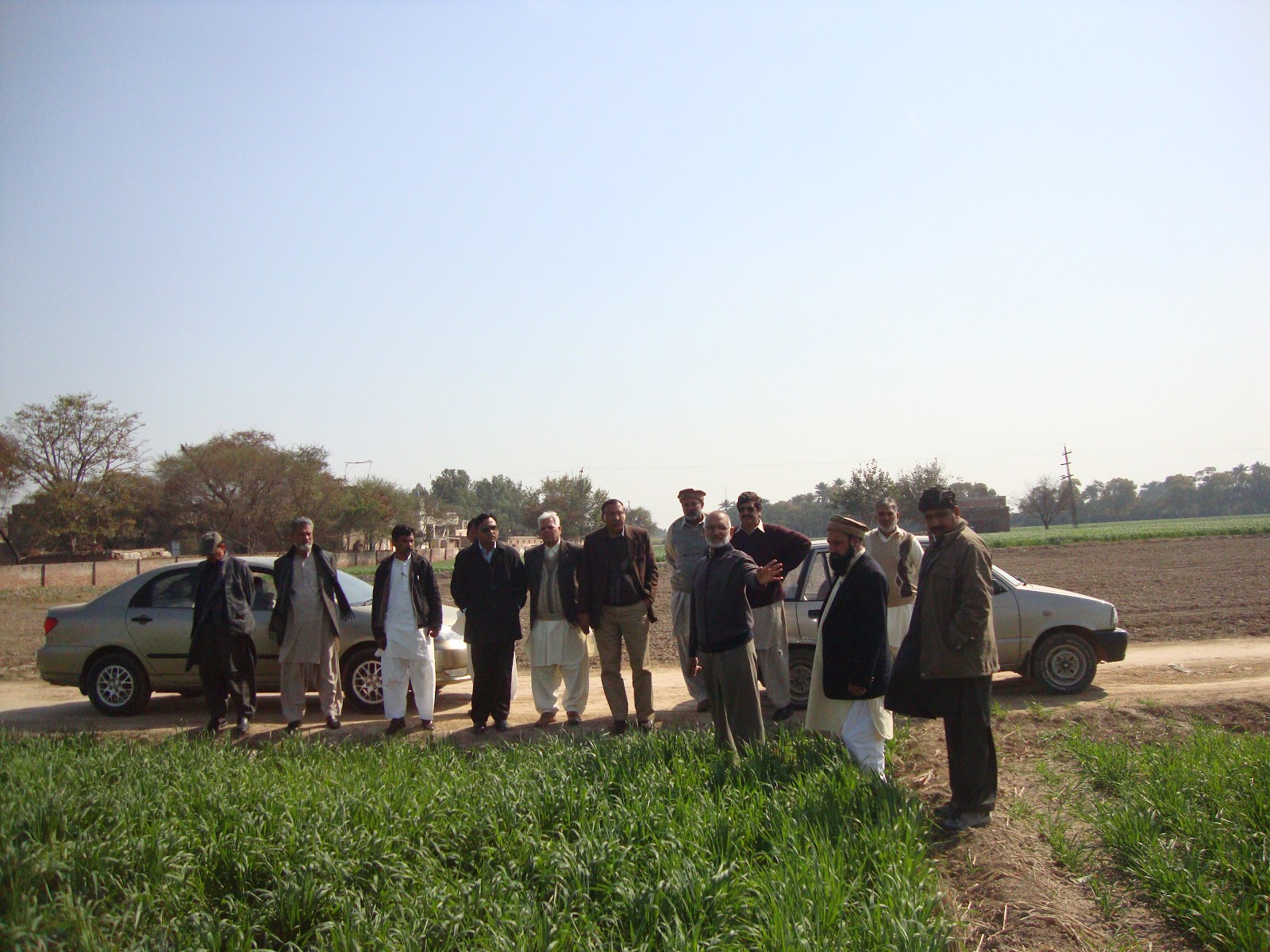
A farmer Rana Tahir Ali planted 2 acres wheat on beds at chak 81/JB Faisalabad. Fauji Fertilizers Company Limited (FFC), the largest fertilizer distributor in Pakistan joined CSISA, Pakistan in this demonstration.  FFC provided the soil analytical facilities, nutrient recommendations and the needed fertilizers. Bed planted crop was late planted on December 21, 2012. Yet the crop was markly superior to CP crop.
FFC held a farmer’s day on 18-04-2012 at the site. One hundred and fifty farmers attended the field day. Farmers were shown around the bed planted field and were explained the technology on site as well as in meeting place. Dr. Muhammad Aqil Khan showed farmers with the help of flexi charts, various CA technologies, their purposes and advantages. Beside wheat based CA technologies he discussed DSR technology for impending rice season. FFC staff discussed the nutrient needs on the wheat crop and facilities they are extending to farmers. At the end there was question- answer session which provided further details of the CA.
Recitation from Holy Quran
Dr. Khan addressing the participants
Participants of the meeting
Participants visiting BP field

Friday, April 6, 2012

Farmers’ training in intercropping of sugarcane in bed-planted wheat and CA practices

A Field Day was held by Engro Fertilizers Ltd. for farmers training in modern sugarcane production practices. CSISA Pakistan was invited to explain sugarcane in BP wheat intercropping and other CA technologies. The FD was held at Jaranwala, approximately 108 farmers and Extension and Engro field staff participated. Opening the seminar Dr. M. Aqil Khan from CSISA, Pakistan dilated on the unfolding agricultural situation, rising food demands and deteriorating terms of crop production – squeezing land, diminishing water availability, rising costs of fertilizers, chemicals and energy. Farmers already are finding agriculture an uneconomic proposition (a farmer had come with his expenditure sheet for producing sugarcane crop showing Rs. 181,000 cost of production per acre). So reducing cost, adding efficiency to inputs and deploying modern practices to increase crop and system yields are key to revitalize agriculture, increase food availability and improve rural economy. Dr Khan explained various CA technologies with the help of flexi charts and field shots of these practices. He explained how these technologies help save water, promote timely crop planting, reduce cost of production and raise multiple crops from a field. Intercropping of sugarcane and mung bean in wheat and relay cropping of wheat in cotton were explained and shown through printed charts to the audience.    At the end DSR was also explained followed by discussion.
             Dr. Aqil Khan addressing participants
Describing CA with the help of flexes


              Engro Representative addressing
Participants of seminar 

Wednesday, March 21, 2012

Farmer’s field day

CSISA, Pakistan and a local fertilizer giant, Engro Fertilizers Ltd. held a field day for farmers to demonstrate the utility of bed planting in enhancing yield and saving water on 8th March, 2012, at Chak No. 296 RB, Faisalabad. The farmer, Raja Asghar Ali, had planted 8 acres wheat on beds using CSISA planter. The crop is heading and showing a comparative edge of bed planting in water saving. The farmer himself was appreciative of bed planting technique. The field day provided the opportunities to the participants to see the bed planted and flat sown wheat themselves and learn from the farmer the comparative difference. Dr. M. Aqil Khan explained to the participants CSISA goals and objectives and the advantages of bed planting.
Engro had put a fertilizer trial to show the role of NPK in raising cop yield. Senior Engro official from Lahore was also present. The field day was chaired by the Dean Faculty of Agriculture, University of Agriculture Faisalabad and Director Cotton Research Institute jointly. For many a farmers bed planting and associated technology was a first time experience and they were generally receptive. 110 persons from research, extension, private sector and farming community participated.
Dr. M . Aqil Khan addressing 
Dean Agriculture, UAF
Director Cotton addressing 
Engro representative
Participants
Field visit

Friday, March 16, 2012

CSISA, Pakistan helps PARC establish Pakistan Cereal Knowledge Bank

Cereal knowledge banks established by IRRI and CIMMYT are popular sites for a variety of people connected with agriculture. These were primarily developed to serve farmers with latest production technology so their economic lot and national food security are improved and have, overtimes, diversified into rich repositories of various facets of agricultural knowledge. In view of their popularity IRRI helped many countries establish their national knowledge banks. Pakistan had yet not one of its own so Dr. Noel Magor and David Shires asked Dr. M. Aqil Khan, CSISA, Pakistan, Coordinator, to help establish cereal knowledge bank in Pakistan during latter’s visit to IRRI in October, 2011. Dr. Khan talked to various persons in Pakistan Agricultural Research Council for the purpose. The chairman was particularly enthused by the idea. He held a meeting with his Scientific Information staff and Dr. Khan and, as a result, Pakistan Cereal Knowledge Bank came into being on 15th February, 2012. IRRI further supported the establishment of CKB by holding a training workshop on CKB held on 14th-15th March, 2012 at National Agricultural Research Centre, Islamabad. Dr. David Shires, IRRI Consultant on knowledge management traveled to Pakistan to conduct the workshop. People from various agricultural fields from all over Pakistan attended the workshop. This helped clarify the purpose and goal of the CKB and its needed mechanism. The participants appreciated the institution of CKB in unison, the Chairman, PARC was particularly forthcoming. In his closing remarks he dilated upon the importance of CKB and identified several other areas for inclusion in the bank and securing local and international support.
                                                     Participants of workshop
                        Chairman PARC (centre), Dr. M. Aqil Khan (left) and David Shires
                                                     Group photo of participants

Friday, March 9, 2012

CSISA, Pakistan celebrates International Women’s Day (IWD)

CSISA, Pakistan in partnership with Ayub Agricultural Research Institute (AARI), Faisalabad, the principal agricultural research site in Pakistan and employing growing number of female staff in office and field positions, celebrated IWD on 8th March, 2012. Director General Agriculture (Research), AARI and a local women leader were in chair. The highlight of the day was a speech competition on women role in nation building. Inaugurating the day the DGA (Res.) Dr. Nur ul Islam, welcomed the CSISA efforts in organizing the IWD which is a first function of its kind in the 60 years history of Institute. DGA spoke of the role of the women in changing the society and promotion of national development. He recounted how AARI has benefited from the newly inducted female staff particularly in strengthening laboratory work. Female workers have proved responsible, diligent and persistent in their work. Naturally the institutional activities are upswing. The female participants one after the other highlighted the women contribution in family life, social, economic and political spheres. Landmark contribution of women in history and shaping the present day world were recounted. It was shown that a determined and dedicated woman can excel in the man dominated world if she is guided by courage, fearless aspirations and determination. A panel of three judges judged the speeches and CSISA, Pakistan presented a shield to the winner, Miss Seher Jamil, Research Officer (Biotechnology). Dr. Abid Mehmod, Director Cotton who represented the DGA after he left invited the women to effectively participate in national progress. He showed that women are facing no discrimination. In fact they enjoy privileged status in Pakistani society; therefore, there is a wide field open for Pakistani women if they shed the historical and cultural taboos. Seventy female workers attended the function. At the end, Dr. M. Aqil Khan, CSISA, Pakistan, thanked the participant for their participation, enthusiasm and bold presentation of their cause.
                                                    DGA presiding the function
                                                  Dr. M. Aqil Khan welcoming
                                                   DG, AARI addressing
                                                   Stage secretary
                                                      Participants of IWD
                                                     Shield presentation

Friday, February 10, 2012

0-til cotton training cum field visit

A farmer’s training at CSISA, Pakistan office was organized on February 09, 2012 in continuation of the efforts to test/demonstrate 0-til cotton planting at farmer’s field. Eight farmers and two private sector persons participated.
After briefing the aim of CSISA, Dr. M. Aqil Khan highlighted the need of conservation agriculture in the scenario of receding land and water availability and increasing population pressure. Benefits of bed planting, 0-til planting and relay cropping of wheat in cotton, inter cropping of sugarcane in bed planted wheat and DSR were explained with the help of flexy charts. Farmers made several queries/observation regarding various aspects of CA. The multifunction CSISA planter also came under discussion.
Emphasizing on cost reduction and successful crop establishment, cotton farmers were explained the last season’s experience of 0-til cotton planting. A leaflet explaining the purpose and methodology of 0-til cotton was also distributed. Dr. Khan urged the farmers to undertake 0-til cotton planting for further testing at their fields to which they agreed. Then, the farmers were taken to the 0-til cotton field, where a healthy discussion took place.  The participants were also visited 0-til and bed planted wheat fields at AARI.
Dr. M. Aqil Khan addressing the participants
ZT wheat field
Bed planted wheat field


ZT cotton field


CSISA planter briefing

Thursday, February 2, 2012

0-til cotton planting training

Cotton is planted in Pakistan in two modes- cotton-cotton and cotton-wheat-cotton. Cotton following cotton (cotton-cotton) is early planted in February/March and is a new trend in cotton cultivation. The crop is long duration and, therefore yields are high. Lately, cotton prices have been rising in international market so farmers are happy with this new planting arrangement. Last year CSISA, Pakistan undertook successful 0-til cotton planting under both panting arrangements. Despite some short comings the 0-til planted crop yields were similar to those of conventional planting. So this year it is being expanded to farmer’s fields for further testing and demonstration. So CSISA has been contacting cotton farmers in various districts. A progressive farmer’s organization in Khanewal invited CSISA, Pakistan to its meeting on 1st  February, 2012 at chak No. 122/15-L (30.37950N, 72.36366 E), district Khanewal. Thirty five farmers were present. Dr. M. Aqil Khan explained to participants general philosophy of CSISA program and, in particular showed last year’s 0-til cotton experience graphically. Farmers were explained the purpose and method of 0-til planting. A field demonstration was also given to the farmers. CSISA, Pakistan distributed a leaflet also explaining the purpose and methodology. A lively discussion followed the discourse by Dr. Khan. Farmers made several queries/observation regarding various aspects of CA. At the end, four farmers volunteered to undertake 0-til cotton planting experimentally at their farms. CSISA aims to expand its contacts further and expects to have some 15 such demonstrations in and out side CSISA hub.
Dr. M. Aqil Khan addressing the participants
Participants
Field demonstration

Zero til cotton planting


Monday, January 23, 2012

Invitation lecture at PMAS Arid Agriculture University, Rawalpindi

Dr. Muhammad Aqil Khan CSISA, Pakistan Country Coordinator was a guest speaker at PMAS Arid Agriculture University, Rawalpindi on 19th January, 2012. He spoke about climate change, agriculture and our option. The talk presented a pretty comprehensive review in the three areas. He discussed the causes, impact and present scenario of well evident climate change phenomena. Using data and graphic presentation, he showed, how over last one hundred and fifty years anthropogenic factors have drastically changed carbon contents of atmosphere and how this added CO2 with other green house gases (GHGs) is affecting the planet temperature and what affect this raised temperature on water reserves (glaciers in high mountains and polar ice areas) have. This is human driven and have accentuated over time with increasing exploitation of natural resources to satisfy industrial-consumer population. Population is increasing and is likely to be over 9 billion in middle of this century. This would accelerate natural resource exploitation further in order to meet human needs. The effect of these factors on Pakistan economy was spelled out showing challenges which lie ahead. This has to be changed, he pointed out, through judicious human efforts. In agriculture, conservation agriculture is decidedly a way out. It ensures simple, cheap, effective and efficient agriculture operations which help maintain growth momentum while cutting energy and labour needs. He explained various CA technologies and the benefits that accrue as a result. At the end, a lively discussion followed and faculty staff and students sought solution to many local problems faced by the local farmers. Finally, Dean/Agriculture who chaired the meeting thanked the speaker and discussed possibility of future cooperation in educating students in CA and helping farmers reap the benefits of this emerging technology. One hundred and fifteen faculty staff and students participated the seminar.
Dr. M. Aqil Khan addressing 
Participants at the occasion